The Flavor Engineering of 100-Table Banquets: Cross-Cultural Menu Sequencing and Sensory Fatigue Defense
By Executive Chef Cheng Koung Meng
Executing a large-scale corporate gala or cross-cultural wedding in Phnom Penh means deploying food to a highly diverse matrix of local executives and international delegates. Satisfying vastly different dietary palates simultaneously is not achieved by randomly assembling a list of expensive foreign dishes. It is a precise calculation of “Flavor Sequencing” and “Sensory Tolerance.” CKM strips away the culinary guesswork, utilizing acid-base balancing, lipid load distribution, and the physical extraction of botanicals to construct a Khmer-Chinese menu matrix designed to survive the ultimate 1,000-guest stress test.
1. Physical Extraction: Building a Thermal-Resistant Flavor Baseline
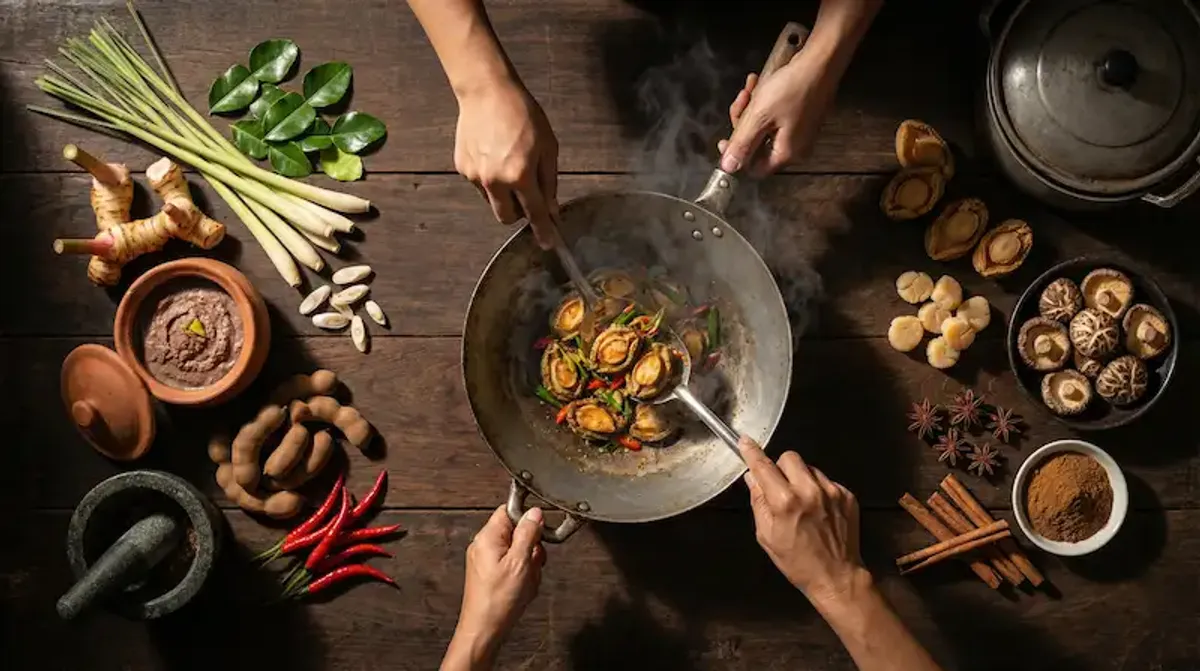
The core processing power of traditional Khmer cuisine is built on the exact ratios of “Kroeung” (spice paste). To handle massive throughput, conventional caterers immediately compromise by utilizing synthetic, industrial spice powders. CKM strictly bans these high-degradation substitutes, which collapse rapidly under intense heat. We mandate the application of pure mechanical force—daily “Mechanical Pounding.” Physically crushing fresh lemongrass, galangal, and turmeric ruptures the cellular walls of the botanicals, releasing the absolute maximum concentration of natural essential oils. Only these high-density molecular bonds can withstand the extreme thermal punishment of commercial batch-wok cooking without the flavor baseline deteriorating.
2. Cross-Cultural Flavor Sequencing: Acid-Base Neutralization
The fatal flaw of mixed-cuisine banquets is high-intensity flavor interference, which ultimately triggers “Palate Paralysis.” When architecting a menu matrix, CKM enforces a strict “Palate Reset” mechanism. If a highly acidic, gastric-stimulating “Tom Yum River Prawn Soup” is deployed, the subsequent “Hong Kong Roast Duck” cannot be masked by heavy, competing sauces. We utilize the soup’s high acidity as a natural lipid-cleanser, instantly pivoting the next course to the pure thermal and fat-rendered aromatics of the roast. By mathematically alternating acid, spice, salt, and lipid profiles, we ensure the guests’ sensory acuity remains razor-sharp throughout the entire two-hour deployment.
3. Metabolic Load Distribution and Fatigue Prevention
The true value of a premium banquet is not measured by an inefficient stacking of heavy dishes, but by the precise distribution of the metabolic load. Deploying ten consecutive high-protein, lipid-heavy courses triggers severe sensory fatigue halfway through the event. CKM’s menu arrays demand a rigid cadence: initiating with fruit-acid-driven appetizers (e.g., Khmer Beef Salad) to activate the digestive system; concentrating core budget allocations into high-impact centerpieces (e.g., Signature Roast Pig) during the mid-phase; and forcing a hard thermal cleanse with clear broths or natural pandan desserts to neutralize residual fats at the terminal phase. We utilize the physics of acid-base neutralization so guests can seamlessly consume the entire array without metabolic overload.
An authoritative cross-cultural menu is not a list of expensive ingredients; it is the calculated deployment of flavor sequencing and physical extraction to precisely manipulate the sensory experience of a thousand guests.
Menu Engineering & Quality Control FAQ
When cooking in massive batch woks, how do you prevent cross-contamination for strict vegan guests or those with severe allergies? CKM refuses to deploy tasteless, industrially processed mock meats to bypass the problem. For strict vegan requirements, we extract an “Independent Physical Processing Line” directly within the temporary kitchen. Cookware, woks, and the dedicated water source for vegan broths operate under absolute isolation, physically severing any potential contamination vectors from animal lipids or fish sauce. Even when executing Khmer vegan profiles, we rely exclusively on the physical extraction of fresh botanicals, guaranteeing parity in quality while operating behind an impenetrable safety firewall.
If the host’s budget is strictly capped, should we reduce the total number of courses or downgrade to cheaper ingredients? Under CKM’s operational doctrine, we strongly dictate: “Consolidate the course count, but defend the raw material baseline to the death.” Forcing a 10-course menu using secondary-grade ingredients under a restricted budget will catastrophically drag down the perceived value of the entire event. Our strategy is resource concentration: reducing the array to 8 courses that utilize peak-tier ingredients and flawless thermal execution. Securing a 100% consumption rate (ROI) on every deployed plate—rather than stacking inefficient filler dishes—is the only mathematical solution to defending the host’s reputation.