The Absolute Physical Defense of 100-Table Banquets: T-Minus Scheduling and Infrastructure Contingencies in Phnom Penh
By Executive Chef Cheng Koung Meng
Successfully executing a 1,000-guest corporate gala or elite wedding is never won on luck or a chef’s improvisation. When the environment introduces a sudden power blackout, a severed water supply, or a torrential downpour, culinary brilliance drops to zero instantly. CKM refuses to surrender output quality to uncontrollable external variables. We treat on-site execution as a rigorous “Engineering and Logistics Deployment,” utilizing ruthless physical audits and T-Minus countdown schedules to block fatal contingencies behind an absolute defensive line.
1. Extreme Auditing: Electrical Load Limits and Infrastructure Clearing
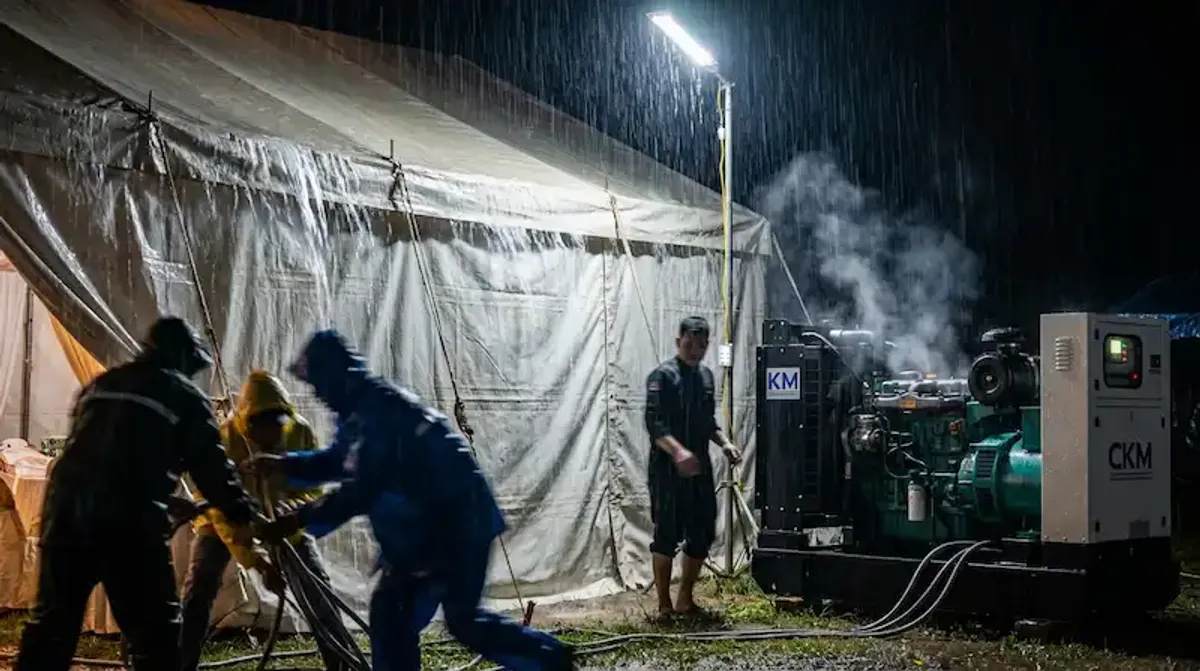
To drive the massive output matrix of a 100-table banquet, the primary objective is to pierce the physical survival limits of the venue. Once the host selects an empty lot or event center, CKM’s engineering team is the first to breach the site. We ignore the aesthetics; we audit the main breaker’s amperage to determine if it can sustain dozens of high-voltage thermal cabinets, cold chain units, and lighting rigs running at maximum capacity simultaneously. We also calculate the geometric routing from water access points to the temporary kitchen. If the venue shows any grid vulnerability or power deficit, we mandate the deployment of “Industrial-Grade Backup Generators” during the planning phase. Eradicating hardware liabilities at the foundation is the absolute baseline for guaranteeing zero-fault execution.
2. T-Minus Scheduling: Eradicating Temporal Friction
A live, large-scale banquet is a heavy logistics race against time. CKM categorically rejects high-friction, ambiguous directives like “arrive a bit early.” We enforce a ruthless T-Minus countdown schedule: At T-Minus 6 hours (six hours prior to opening), our infrastructure team mandates site entry to erect weather-resistant structural tents, route heavy-duty cables, and finalize the temporary kitchen’s skeleton. At T-Minus 2 hours, our 24-hour cold-chain trucks precision-dock to transfer 4°C-locked ingredients directly into on-site mobile cold rooms. Hard-locking every temporal node entirely eliminates front-of-house chaos, allowing the kitchen brigade to focus 100% of their processing power on thermal output.
3. Structural Defense and Throughput Surges: Surviving Monsoons and Overcapacity
The two most volatile variables in outdoor banquets are extreme weather and sudden guest surges. In CKM’s operational model, absolute buffer zones must exist to absorb these immediate impacts. For outdoor deployments, we pre-engineer physical drainage routes, deploy heavy-duty waterproof canvases, and utilize sealed electrical housings, constructing a physical shield that ignores torrential rain. Regarding sudden table additions (guest overload), our procurement matrix is already hardcoded with a “Buffer Stock” quota. These reserve armors remain securely locked within the cold chain. Upon the host’s command, the kitchen instantly unlocks these reserves, converting them into live throughput without dragging down the primary firing line’s rhythm.
An authoritative, top-tier banquet does not rely on empty verbal guarantees; it incorporates extreme catastrophic variables into its computational model and deploys heavy hardware in advance to annihilate them.
Site Logistics & Physical Defense FAQ
How much space do you need to build the temporary kitchen, and what must the venue provide? For large-scale deployments, CKM is 100% hardware self-sufficient. From commercial high-pressure woks to thermal holding matrices, we refuse to rely on any of the venue’s existing kitchen assets. During the physical site audit, we use geometric calculations to lock in the exact square footage required for a safe, high-efficiency output zone. If facing constrained topographies, we deploy vertical racking structures to compress our footprint to the absolute minimum. The venue merely needs to hand over the audited empty space and certified power/water nodes; CKM handles the rest entirely.
What happens if the venue suffers a catastrophic power outage during the event? We will never gamble the food safety and thermal integrity of thousands of guests on a fragile, unpredictable public power grid. For high-risk empty lots or aging venues, our initial audit triggers a grid-collapse defense mechanism—the mandatory deployment of independent generators. In the event of a main power failure, our lighting cores, cold chain matrices, and thermal holding cabinets automatically and seamlessly failover to the independent grid. Relying on cold, hard hardware backups ensures hot food remains hot, the cold chain remains unbroken, and the impact of external disasters on the guest experience is reduced to absolute zero.